.png?width=200&height=52&name=Adikteev-H-White%20(1).png)
CTV drives mobile installs. It builds intent, nudges users towards conversion, and influences far more installs than they get credit for. The trouble is that most attribution setups were not built for cross-device journeys, so they under-report CTV. And when you finally credit it properly, its share rises while organic falls, which can look like CTV is stealing from organic.
Neither of those is real performance. Both come down to how your MMP handles CTV, and both are fixed with the same short framework. Here is how the attribution actually works, why CTV gets under-credited, why it is not cannibalising your organic, and the two settings that put it right.
How CTV attribution actually works
CTV is a post-view channel. Nobody clicks a television, so there is no click to attribute against. Instead, your MMP credits a CTV install by matching the IP address of the household that saw the ad to the device that later installed the app on the same network. That household-level, IP-based match is the foundation of everything below.
Why CTV gets under-credited
Two things work against CTV in a standard attribution setup.
1. It sits at the bottom of the attribution waterfall
Your MMP decides which touchpoint gets credit for an install using a priority order, highest to lowest: deterministic click (owned media, self-reporting networks like Meta and Google), then deterministic view, then probabilistic click (programmatic, web, email), and last of all probabilistic view, which is where CTV lives.
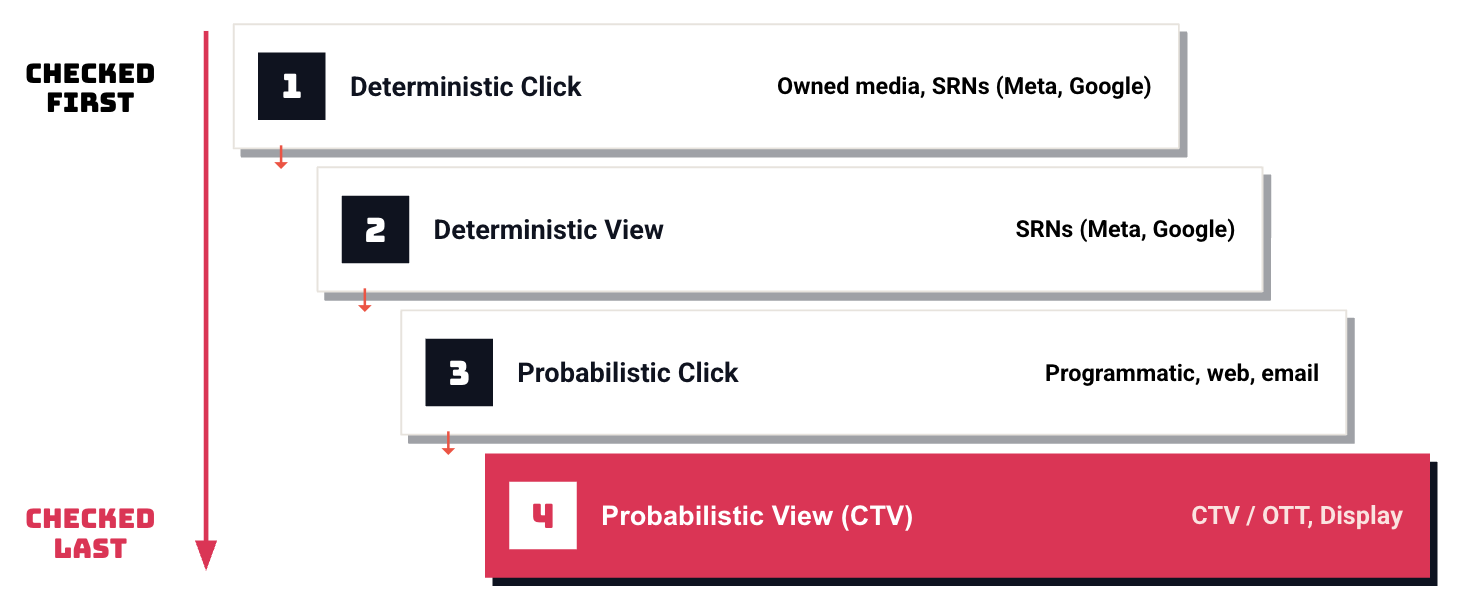
Because IP rather than a device ID matches CTV, your MMP files it as a probabilistic view, the lowest tier, so clicks are prioritised over impressions and device ID matching is prioritised over probabilistic modelling, which leaves CTV far down the attribution waterfall. By default, it only claims an install when no higher tier can.
So if a user sees your CTV ad, is then served a mobile ad, and installs, the mobile ad receives all the credit even though the CTV ad created the intent. Two things follow: you undercount CTV's real contribution, and your budget decisions tilt towards the channels that only appear more effective.
2. Its installs arrive on a long tail
CTV installs are long-tailed. People see an ad on the big screen and act later, often days later. In one of our campaigns, only 14% of installs landed within 24 hours of the ad, while 60% came in only after seven days. With a short view-through window, most of those real installs fall outside it and get logged as organic.
CTV isn't poaching organic, it's reclaiming its own
This is where the cannibalisation worry comes from. Once CTV is credited properly, you see CTV-attributed installs rise and organic fall, and it looks like CTV is poaching organic. It isn't, and the waterfall is the reason.
A CTV view only counts when no click or deterministic touch exists. It can never override a genuine organic or click-based install. What actually happens is that installs a CTV ad really drove, which a short window had filed as organic because it could not see the impression, get correctly reassigned to CTV. The credit was always CTV's. When the window is too short, roughly two-thirds of CTV installs are misread as organic this way (Adikteev internal data, 2025). Fixing your settings does not move real organic installs over to CTV. It stops real CTV installs from being mislabelled as organic in the first place.
The fix
1. Set an equal attribution priority window
This is the fix for CTV's place at the bottom of the waterfall. By default, CTV sits last in the priority order, so any competing touchpoint beats it. An equal attribution priority window fixes that.
For a defined period after the impression, it gives the CTV impression the same attribution priority as a deterministic click, so within that window CTV is eligible for credit on equal terms rather than ranked last by default.
That changes three things: CTV-driven conversions surface in reporting instead of being lost to lower-priority signals, cross-device budget decisions start reflecting real behaviour, and upper-funnel activity finally gets recognised in the journey
| Note: This does not override deterministic clicks. When a real click exists, it still wins. The equal-priority window applies only when the attribution decision involves competing probabilistic signals, ensuring CTV is measured fairly rather than preferentially. |
2. Extend the view-through window
This is the fix for the long tail. Raising CTV's priority only helps if the install still falls inside the lookback window, and these installs arrive late. The view-through attribution (VTA) lookback window sets how far back your MMP will look for a CTV impression when an install happens. Leave it at 24 hours and you miss the long tail. Extend it, and the later installs are matched to the impression that actually drove them instead of disappearing into organic. AppsFlyer's recommended cross-platform VTA window is 72 hours, which is the figure we use.
We have covered equal attribution priority windows in more depth before, with a step-by-step walkthrough for each MMP. For the detailed version, read How to Know the Real Value of Your CTV Campaigns.
The bottom line
None of this inflates CTV. It lets the channel compete on fair terms, long enough to show what it is really doing. Set the window to match how people actually convert, give CTV equal footing against other probabilistic signals, and your reporting starts crediting the installs CTV was driving all along, instead of handing them to organic.
If you have not set this up yet, you are almost certainly undercounting CTV and making budget calls on numbers that were never telling the whole story. And once the numbers are honest, the next question follows naturally: of the installs CTV is now credited with, how many would not have happened without it? That is incrementality, and it is the measure that ultimately justifies the spend.